Last week we went
camping with
several other families. The highlight of our trip was a journey to get
a close-up view of Mt. St. Helens. From where we were camping, we drove
up the north fork of the Toutle River to Johnston Ridge. I was 12 years old when the big eruption destroyed Mt. St. Helens. I lived just south of
Portland, so we did not get the worst of the effects, but I do remember
my older brother's baseball games got canceled due to volcanic ash. I also remember going on a day trip with parents to see the damage. We drove for hours through miles of a grey, devistated, dead landscape.
This bridge is at the edge of the blast zone. As you can see, the trees in the area have really grown a lot in 32 years. This land is owned by Weyerhaeuser, and they replanted the area with noble fir. The National Volcanic Monument has not been replanted. Instead, life is being allowed to come back naturally, under close observation by scientists.
We drove all the way up Spirit Lake Memorial Highway to
Johnston Ridge Observatory, which is located less than 5 miles from the volcano. This is as close as you can go without a special permit. The Observatory is named after David Johnston, the volcanologist who died on duty when the big eruption hit.
The big eruption took place in several quick stages. First, the top and north flank of the mountain slid down and slammed into Spirit Lake and Johnston Ridge. The landslide scoured the ridge down to bare stone, then was deflected into the Toutle River valley. This was the biggest landslide in recorded history. The water in Spirit Lake was completely displaced, then washed back to settle on top of the landslide, 200 ft higher than it had been before. Many new lakes were formed by the landslide, including Castle Lake, which you can see in the distance in this picture.
As soon as the mountain fell, the pressure on all the heated water inside it was released, creating a giant steam explosion called the lateral blast. The lateral blast was fast, hot and deadly. It hit Johnston Ridge in about 40 seconds. The area between the ridge and the volcano used to be old growth Douglas Fir forest. The lateral blast shattered the trees to splinters. This photo shows the stump of a shattered tree.
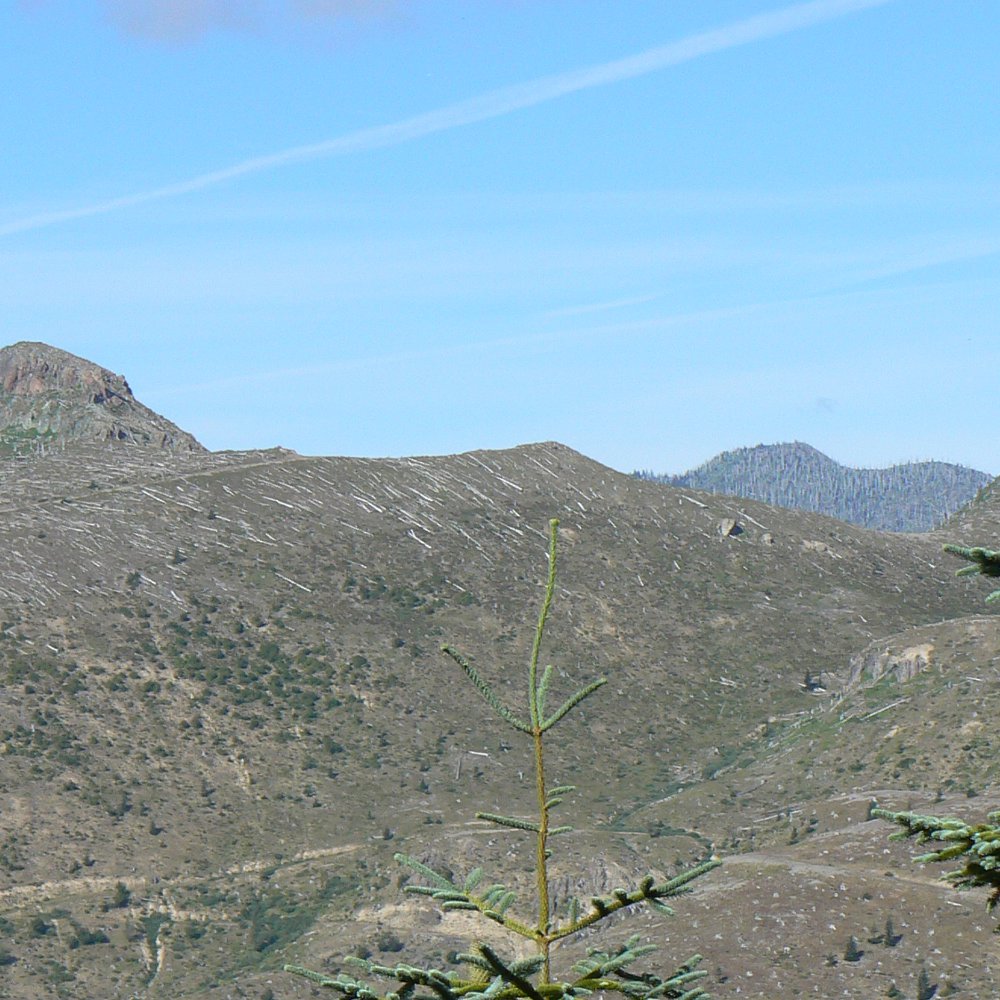
By the time the blast hit the ridge, the largest rocks had dropped out of the blast cloud. Beyond the ridge, the remaining small rocks knocked over all the trees less than 8 ft in diameter. Eventually the small rocks dropped out, but the hot gasses continued to expand out, killing another section of forest where it stood. In the picture below, the trees on upper part of the ridge in the foreground were knocked over. Behind that, in the background, is another more distant ridge where the trees were killed in place.
After the lateral blast, pyroclastic flows of gassy lava poured out of the volcano. Mudflows filled the Toutle River and blocked shipping in the Columbia River. And, of course, ash poured out of the volcano.
What's amazing to me is to see how much life has returned. In May of 1980, there was still a lot of snow on the ground at this elevation (4400 ft). The hot lateral blast passed through so quickly that small mammals and trees hidden under the snow survived. I was surpised to learn from the park ranger that silver fir were big survivors of the eruption. In the old growth forest, small silver fir would lurk near the forest floor waiting for a Douglas fir to die. As soon as a path to the light opened up, they would shoot for the sky. Lots of silver fir survived and are now quickly growing up.
One of the areas that is most resistant to the return of plant life are the pyroclastic flows near the volcano. The new soil is very nutrient poor. One plant is making great inroads, though. Lupine, a relative of the pea that does well at high altitudes, is one of the first plants to move in. It is able to add nutrients to the soil, so more plants will soon follow.
Mt. St. Helens has continued to erupt since 1980. The more recent eruptions have built a dome of lava in the crater. In the close up picture, you can see the glacier that has formed on either side of the lava. Even though the lava looks like it is steaming, the surface is not hot right now. The steam is caused by gasses escaping from the volcano.
The more recent eruptions can still pack a bit of a punch, though, as you can see in this picture. The twisting piece of metal is a scientific monitoring instrument that got caught in a steam blast.
Visiting Mt. St. Helens really brings home just how fragile life is. Yet at the same time, life is incredibly resilient. Even Spirit Lake, which was totally dead and full of mud and ash and dead trees after the eruption, is now thriving with life. The grey, lifeless hills that I remember right after the blast are now covered with trees and meadows. Elk, deer and coyote have moved back into the area.
How about you? Do you know of an inspirational place or story that brings home just how precious life is?
(And, for those of you who made it to the end of this very long post, thanks for hanging in there with me!)